Cobia Fishing Guide: Sight Casting, Chumming, and Migration Timing
Picture this: You're running along the Mid-Atlantic coast in late April, scanning the surface with a pair of polarized glasses pressed to your face. Then you see it — a dark, torpedo-shaped shadow cruising just below the chop, maybe 40 yards off the bow. Unhurried. Completely unaware. You've got maybe 30 seconds to make a cast.
That's cobia fishing. And once you've had that moment, not much else on the water quite compares.
Full disclosure: I'm primarily a freshwater kayak angler — bass, walleye, smallies in Ozark streams. But I've made a habit of chasing cobia every spring when I visit family down in Virginia Beach, and over the last five years or so, I've picked up enough from local guides and my own trial-and-error to have real opinions on how this fishery works. Cobia hit differently than anything I've encountered in fresh water, and the tactics are surprisingly learnable even if you're not a saltwater regular.
This guide covers when cobia show up along the East Coast, where to look for them, how to sight cast effectively, how to chum where it's legal, and how to handle fish properly so this fishery stays healthy for the next person behind you.
Understanding the Cobia Migration
Cobia (Rachycentron canadum) are migratory fish that overwinter offshore or in warmer southern waters, then push north along the Atlantic coast as water temperatures climb each spring. According to NOAA Fisheries, cobia range across the entire U.S. Atlantic coast and Gulf of Mexico, but the spring migration through the Mid-Atlantic is particularly fishable because fish often travel in loose, visible groups near the surface — which is exactly what makes them so exciting to target.
When Do Cobia Arrive?
Migration timing shifts depending on how quickly water warms in a given year, but here's a reasonable framework for planning:
| Region | Typical Arrival Window |
|---|---|
| North Florida / Georgia Coast | Late February – March |
| South Carolina & North Carolina | Late March – April |
| Virginia Beach / Chesapeake Bay | Late April – June |
| Maryland / Delaware | May – June |
Water temperature is the real trigger. Cobia generally become active and start moving inshore when surface temps reach 68–72°F. Once you're seeing consistent readings in that range for your area, it's time to start looking seriously.
The Chesapeake Bay mouth — particularly around the Chesapeake Bay Bridge-Tunnel (CBBT) — is arguably the most well-known cobia destination on the East Coast. Fish funnel through in significant numbers during May, drawing anglers from multiple states. But the broader stretch from the Outer Banks north to the Delmarva Peninsula produces fish throughout the migration window, and the CBBT crowds aren't for everyone.
What Drives Their Movement?
Cobia follow two things above all else: warm water and food. They're frequently spotted around structure — buoys, channel markers, crab pot floats, bridge pilings — and perhaps most reliably, they travel in the company of other large animals. Cobia commonly shadow cownose rays, which run their own northward migration each spring. If you spot a school of rays rolling near the surface, slow down and look hard. Cobia are often mixed right in with them, or cruising just behind.
Before heading out, I check HookCast's tide charts for my area to build my run around incoming tides, which tend to push bait — and the fish chasing it — toward structure and inlet edges.
Sight Casting for Cobia: The Most Exciting Approach
If you've ever bow-fished for carp in a shallow pond, you already understand the mental framework. Sight casting to cobia is about spotting, positioning, and presenting before the fish knows you're there. Everything happens fast, and most of what determines the outcome happens before the cast.
Finding Fish on the Surface
Cobia cruise near the surface, especially on calm, low-wind days. A flat, glassy surface is your best friend — you can spot fish 50–100 yards out with good eyes and good glass. When chop builds, fish are still there; they're just harder to see, and you lose that positional advantage that makes sight casting so effective.
Things to look for:
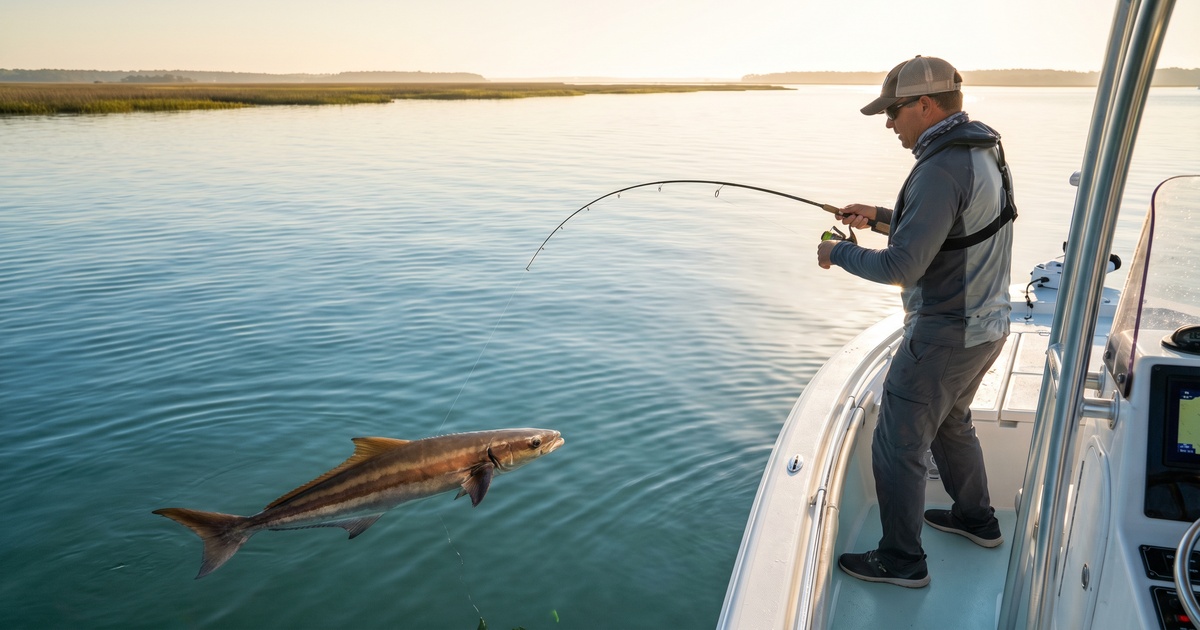
- Dark, elongated shadows just below the surface — cobia are brown-bronze on top, cream on the belly
- Fin tips breaking the surface, especially the distinctive first dorsal spines that look almost shark-like
- Rays and sharks — scan what they're traveling with
- Low-flying birds working near bait schools
Running from a tower or elevated platform gives you a meaningful edge. Even standing on a cooler or a poling platform on a flats skiff improves your detection window significantly. I've also spotted cobia from a kayak — paddling quietly along channel edges in the lower Bay — but the game changes considerably when you're that close to the waterline and can't cover ground quickly.
The Cast
When you spot a cruising cobia, time compresses. Here's the basic sequence:
- Don't run at the fish — cut the engine early and close the distance with a trolling motor or by drifting
- Get within comfortable casting range — typically 40–60 feet for most anglers
- Lead the fish — place the lure 6–10 feet in front of where it's headed, not directly on top of it
- Let the lure sink briefly, then begin a moderate retrieve that intercepts the fish's path
Cobia are aggressive feeders, but they spook when something crashes on their head. The goal is to appear in their path, not ambush them from above.
Best Lures for Sight Casting
Soft plastics are the standard choice for most East Coast cobia anglers:
- Eel imitations — 8–12 inches on a 1–3 oz jig head depending on depth and current
- Paddle tails — 5–7 inch range in chartreuse, white, or natural colors
- Bucktails — old-school but consistently effective, especially in current
Hard baits also produce:
- Large swimbaits for fish that want something substantial
- Topwater plugs when fish are actively working the surface
One principle most experienced cobia anglers agree on: match your retrieve speed to what the fish is doing. A slow-moving cobia cruising with rays probably needs a slow, sinking presentation. A fish pushing hard and feeding actively will sometimes crush a fast-moving paddle tail without hesitation.
Field note: On my best cobia day near Cape Henry, a buddy and I found fish trailing rays in about 15 feet of water. Both fish that ate came on slow-sinking eel rigs. The fish that ignored us were tight to a fast-moving group — probably already spooked from a boat that had run through earlier that morning.
Chumming for Cobia: Consistency When Conditions Work Against You
Sight casting gets most of the attention, but chumming is how a lot of anglers put consistent fish in the boat, particularly when wind chops up the surface and visual fishing becomes a grind.
Check the Regulations First
Before anything else — verify whether chumming is legal where you're fishing. It's permitted in most Mid-Atlantic and Southeast nearshore environments, but rules vary by state and specific location. Some areas near inlets or within certain distances of public beaches may restrict or prohibit it entirely. Check with your state's marine fisheries agency before setting up a slick.
Where to Anchor and Chum
Productive chumming spots generally share a few characteristics:
- Active current to carry the scent slick downtide
- Nearby structure — channel edges, buoys, wrecks, or reef areas
- Depth in the 20–60 foot range, particularly near inlet mouths or channel bends
The setup is straightforward: anchor uptide of your target structure and let the chum drift back toward it. Cobia will follow the slick to its source.
What to Use
Chum options:
- Frozen menhaden/bunker blocks — slow-melting, steady slick, easy to manage
- Fresh-ground menhaden or mackerel — stronger scent, disperses faster
- Crab pieces — particularly effective in areas with high crab populations
Live bait options (where permitted):
- Eels — arguably the top live bait for cobia across the East Coast
- Large pinfish or spot — locally available and easy to keep lively
- Peeler crabs — exceptionally effective in the Chesapeake Bay, especially May through June
When fishing live bait in a chum line, freeline the bait back into the slick or use a fish-finder rig rather than pinning it down with a heavy sinker. Cobia often take baits near the surface or at mid-column, and a bait locked to the bottom is a missed opportunity.
Gear for Chumming
Cobia are powerful, no-nonsense fish. A 40-pounder on light tackle will teach you something about your gear in a hurry. Standard setup:
- Rod: 7–7.5 ft medium-heavy to heavy spinning or conventional
- Reel: Size 5000–8000 spinning, or conventional equivalent
- Line: 30–50 lb braid with a 60–80 lb fluorocarbon leader
- Hook: 6/0–8/0 circle hook for live bait — reduces gut-hooking and improves survival on released fish
Reading Conditions: When to Go and When to Stay Home
Cobia fishing is heavily influenced by conditions in ways that aren't always obvious at first. I've had days where fish were everywhere, and days with nearly identical-looking forecasts where we ran all morning and came up empty. A few patterns have proven consistently reliable.
Tides and Current
Moving water almost always outperforms slack tide for cobia. Incoming tides push warmer, cleaner water toward structure and tend to activate feeding. On the Chesapeake, a lot of experienced local anglers prioritize the two hours before and after high tide near the CBBT — it's worth building your schedule around rather than arriving at an arbitrary time.
Checking tide charts for your area the evening before your trip gives you time to actually plan your drift and anchor positions rather than scrambling to react once you're out there.
Wind and Sea State
Light wind — 5–10 mph — is the sweet spot for sight casting. Enough to mask boat noise, not so much that surface chop eliminates visibility. Once wind climbs above 15–20 mph, visual fishing becomes genuinely difficult, and for smaller boats, conditions in open coastal water can cross from uncomfortable into dangerous.
A word on safety: Cobia fishing often takes you well outside inlets into exposed coastal water. Check the marine forecast before launching and take it seriously — a 2-foot sea can build to 4–5 feet quickly when a front moves through. If you're running offshore or into exposed areas, file a float plan with someone onshore before you leave.
Barometric Pressure
Like most fish, cobia feed more aggressively during stable or slowly rising pressure. A sharp drop ahead of a passing front often shuts the bite down. You can check current weather and pressure trends on HookCast before your trip — standard atmospheric pressure sits around 1013.25 hPa per NOAA, and anything declining quickly is a reliable signal that conditions are about to deteriorate.
Regulations, Handling, and Conservation
This fishery carries real pressure. The spring migration concentrates cobia in predictable locations, which means they can be overharvested if anglers aren't thoughtful about it. The rules exist for a reason.
Know the Regulations Before You Launch
Cobia regulations vary significantly by state and change season to season. The Atlantic States Marine Fisheries Commission (ASMFC) manages cobia under a coastwide plan that includes size and bag limits, but individual states implement their own specific rules on top of that framework.
A few examples of why you need to verify locally rather than assume:
- Virginia has maintained a one-fish-per-person daily limit with a 37-inch fork length minimum in recent seasons
- North Carolina rules may differ, especially around the Outer Banks
- Gulf Coast states operate under separate federal and state regulatory frameworks entirely
Check your state marine fisheries website before every trip. Regulations change, and not knowing the current rules doesn't protect you on the water.
Handling Cobia Correctly
Cobia are strong, sharp-spined fish. Handle them with care:
- Lip-gripping tools work on smaller fish, but larger cobia should be cradled horizontally with support under the body
- Avoid holding a big fish vertically by the jaw — it stresses both the jaw and internal organs
- Wet your hands before handling any fish you plan to release
- Minimize air time on released fish. Get the hook out, support the fish in the water, and let it swim away under its own power
If you're keeping a fish — and cobia is genuinely excellent table fare — bleed it immediately in the water and get it on ice as quickly as possible. How you treat the fish from that point forward shows in the quality of the meat.
Worth noting: Circle hooks aren't just a conservation practice — they're arguably more effective with live bait because the hookset happens on its own as the fish turns. Let the fish move, come tight, and the hook seats in the corner of the jaw. Better hookup percentages, better outcomes for released fish.
Quick-Reference Checklist: Cobia Trip Planning
Before You Go:
- [ ] Confirm water temps in the 68–72°F range for your area
- [ ] Check tide charts and plan your drift or anchor timing around them
- [ ] Review the marine weather forecast — wind, seas, and pressure trend
- [ ] Verify current cobia regulations for your specific state
- [ ] File a float plan if running into exposed or offshore water
Gear Essentials:
- [ ] Medium-heavy to heavy rod, 7–7.5 ft
- [ ] 30–50 lb braid + 60–80 lb fluorocarbon leader
- [ ] 6/0–8/0 circle hooks for live bait
- [ ] 1–3 oz jig heads for soft plastics
- [ ] Eel imitations, paddle tails, or large swimbaits
- [ ] Chum (if chumming — confirm it's permitted at your location)
- [ ] Quality polarized sunglasses — non-negotiable for spotting fish
On the Water:
- [ ] Approach spotted fish slowly — cut the engine well before you're close
- [ ] Lead the fish with your cast, not on top of it
- [ ] Scan around rays and sharks for traveling cobia
- [ ] Match your retrieve speed to how the fish are behaving
- [ ] Wet your hands before handling any fish you're releasing
FAQ
When is the best time to catch cobia on the East Coast?
Peak cobia migration along the Mid-Atlantic coast typically runs from late April through June, with Virginia and the Chesapeake Bay seeing the heaviest concentrations in May. Fish show earlier in the Carolinas, often from late March into April. Water temperature is the primary trigger — consistent surface temps in the 68–72°F range signal that the bite is turning on.
What is the best bait for cobia?
Eels are widely regarded as the top live bait for cobia in Mid-Atlantic waters. Peeler crabs are particularly effective in the Chesapeake Bay region during spring. On artificials, large soft plastic eel imitations on heavy jig heads are the standard sight-casting choice, with paddle tails and bucktails also producing consistently. Retrieve speed matters — match your presentation to how actively the fish appear to be feeding.
How do you sight cast to cobia?
Sight casting to cobia means visually locating fish near the surface before you make a cast. The fundamentals: run slowly on calm days to spot shadows or fin tips, approach quietly by killing the engine well before you're in range, and lead the fish with your lure — placing it 6–10 feet ahead of where the fish is traveling. Quality polarized sunglasses are essential for seeing fish before they see you.
What gear do I need for cobia fishing?
A medium-heavy to heavy 7–7.5 foot spinning or conventional rod paired with a size 5000–8000 reel is the standard setup. Spool with 30–50 lb braid and add a 60–80 lb fluorocarbon leader. Circle hooks in the 6/0–8/0 range are well-suited for live bait, while 1–3 oz jig heads are standard for soft plastics. Cobia are strong, fast fish that will test your gear — don't underestimate them on lighter tackle.
Do I need a saltwater fishing license to catch cobia?
Yes. Cobia are a saltwater species, and a valid state saltwater fishing license is required wherever you're fishing. Most East Coast states also maintain specific size and bag limits for cobia that have shifted in recent seasons due to coastwide conservation management through the ASMFC. Always check your specific state's marine fisheries website before launching — regulations vary by state and can change from one season to the next.